Last week we shared a 3-D view of the area being studied by the Opportunity rover on Mars; now here’s a color view of this stunning landscape on Mars. Both views are the handiwork of Stu Atkinson, a member of Unmanned Spaceflight and author of the Road to Endeavour blog. This is actually an ejecta field of rocks thrown about after the impact that created this huge crater where the rover is now traversing, and is an exciting region for the MER scientists to explore. Look for more great views of this region as Oppy makes her way around, and eventually inside the crater.
Stu tells us that no one should get too excited about the “green stuff” showing up on some of the rocks, as it certainly is not algae or moss or anything like that. “It’s just the colour balance I’ve gone with and the techniques I use,” he said. “Other versions by people with better software and processing skills than myself will no doubt show that green stuff isn’t anything of the kind, but this is the best I can do. And I unashamedly and apologetically go for ‘pretty picture’ rather than ‘scientifically 100% accurate’. That’s NASA’s job. When their version of this scene appears, it’ll be rather different, I’m sure.” Thanks to Stu for sharing this image! More Cool Sites Here!!
Yikes! This science-fiction-like scene was captured by Martin Kornmesser, a visual artist for the European Southern Observatory. Just as the ESO was testing a new laser guide star unit at the Allgäu Public Observatory in Ottobeuren, Germany, a thunderstorm erupted, throwing down bolts of lightning. The folks at ESO say this is a “very visual demonstration of why ESO’s telescopes are in Chile, and not in Germany.” Although the storm was still far from the observatory, the lightning appears to clash with the laser beam in the sky. Laser guide stars are one type of adaptive optics astronomers use to correct for the blurring effect of the atmosphere in astronomical observations. The laser creates an artificial guide star 90 kilometers up in the Earth’s atmosphere. The laser in this photograph is a powerful one, with a 20-watt beam, but the power in a bolt of lightning peaks at a trillion watts — although it lasts for just a fraction of a second. Shortly after this picture was taken the storm reached the observatory, forcing operations to close for the night. See more info at the ESO website. More Cool Sites Here!!
New images of the Apollo 12, 14 and 17 landing sites are the highest resolution pictures ever of human forays onto another world, as seen from a bird’s eye view — or in this case, a satellite’s eye view. The Lunar Reconnaissance Orbiter dipped to a lower altitude, just 21 kilometers (13 miles) over the lunar surface. “We like to look at the Apollo landing site images because it’s fun,” said LRO principal investigator Mark Robinson at a media briefing today. “But LROC (Lunar Reconnaissance Orbiter Camera) is looking at the whole Moon, and we have now taken 1,500 of these very high resolution images from all around the Moon which will help scientists and engineers to plan where we want to go in the future.”
Apollo 17 landing site taken by LRO in its lower orbit, with 25 cm per pixel. Credit: NASA/Goddard/ASU
Apollo 17 landing site from the regular 50 km altitude and about 50 cm per pixel. Credit: NASA/ Goddard/ ASU
Compare in the images above the Apollo 17 landing site with 25 cm per pixel (top) and 50 cm per pixel (bottom). Most notable are the tracks where the astronauts walked show up better, and details of the landers/descent stages can be resolved better. Robinson said he was looking at the new images of the Apollo 17 landing site in Taurus Littrow Valley with Apollo 17 astronaut Jack Schmitt and Schmitt said “You need to image the whole valley at this resolution!” This is the third resolution of Apollo sites that the LRO team has released — the first came from LRO’s commissioning phase where the altitude was about 100 km and the resolution was about 1 meter per pixel; next came the release of images from an altitude of about 50 km, with a resolution of about 50 cm per pixel; and now from about 21-22 km altitude with a resolution of 25 cm per pixel. “These are the sharpest images of Apollo landing sites we’ll probably ever get with LRO,” said Rich Vondrak, LRO project scientist, “as we’ll never go as low in altitude as we were in the past month.” LRO has now returned to its circular orbit of 50 km above the surface. This altitude requires monthly reboosts and since keeping LRO in that orbit would quickly exhaust the remaining fuel, in mid-December, LRO will move to an elliptical orbit, (30 km over south pole and 200 km over north pole). LRO will be able to stay in this orbit for several more years. “This has been a highly productive mission, releasing a total of 245 terabytes of data — which would be a stack of 52,000 DVDs,” Vondrak said. Next week the science team will put out their 7th public release of data to the Planetary Data System, making all that data available to the public.
The paths left by astronauts Alan Shepard and Edgar Mitchell on both Apollo 14 moon walks are visible in this image. (At the end of the second moon walk, Shepard famously hit two golf balls.) The descent stage of the lunar module Antares is also visible. Credit: NASA's Goddard Space Flight Center/ASU
Robinson noted that the details of what pieces of equipment are in each location are verified by images taken from the surface by the astronauts. He was asked about the flags and if they are still standing: “All we can really see is the spots where the flag was planted because the astronauts tramped down the regolith. I’m not sure if the flags still exist, given the extreme heat and cold cycle and the harsh UV environment. The flags were made of nylon, and personally I would be surprised if anything was left of them since it has been over 40 years since they were left on the Moon and the flags we have here on Earth fade after they are left outside for one summer. If the flags are still there they are probably in pretty rough shape.”
The tracks made in 1969 by astronauts Pete Conrad and Alan Bean, the third and fourth humans to walk on the moon, can be seen in this LRO image of the Apollo 12 site. The location of the descent stage for Apollo 12's lunar module, Intrepid, also can be seen. Credit: NASA/Goddard/ASU
Since we can still see the tracks and equipment looking unchanged (at least from this vantage point) one reporter asked if these items will be on the Moon forever. “Forever is a long time, so no, they won’t be there forever,” Robinson replied. “The Moon is constantly bombarded by micrometeorites, and slowly over time the tracks will disappear, then the smaller pieces of equipment will disappear, and eventually the decent stages will probably get blasted by an a larger asteroid. The estimate is that rocks erode 1 mm per million years. In human terms it may seems like forever, but geologic terms, there will be no traces of Apollo exploration in 10 to 100 million years.” More Cool Sites Here!!
The International Space Station has had a continual human presence for nearly 11 years, and so the astronauts now aboard the ISS are holding out hope that they won’t have to break that streak and turn out the lights and close all the hatches when they leave. Ron Garan and Mike Fossum said in a news conference with reporters on Tuesday that they have not yet been training for the possibility that they will have to leave the ISS unmanned due to a problem with the Soyuz rocket, the only ride astronauts and cosmonauts currently have to space.
“It’s too early for us to get too worried about that, frankly,” said Fossum, “and we haven’t started to do anything specific up here,except for documenting things we do on video. Fossum added that teams in mission control in Houston and Moscow are figuring out the procedures of what needs to be done if a problem with the Soyuz rockets can’t be figured out by November. “It will take us a few weeks to finish that up, but we have another nine or so weeks here, my crew of three. So we’ve got plenty of time for those kinds of things.” Fossum said the ground crews are in the preliminary stages of deciding everything, “from what ventilation we’re going to leave running, what lights we’re going to leave on, what condition each particular experiment will be on, every tank, every valve, every hatch.” A Russian rocket carrying a Progress resupply ship failed just after the third stage ignition two weeks ago and crashed into Siberia. While the Progress cargo ships launch on a Soyuz-U rocket and the Soyuz crew capsules — the Soyuz TMA — launches on a Soyuz-FG, the third stages of the two rockets are virtually identical. Russian engineers said last week a malfunction in the third stage engine’s gas generator occurred; now they need to find out why and launch a couple of unmanned rockets before putting humans on board. Right now a crew of six is on the station, with three of them scheduled to depart late next week – a week later than originally planned — to keep the station fully staffed as long as possible. A new crew of three was supposed arrive later this month, but that flight is on hold at least until early November, depending on the outcome of the investigation by the Russian engineers. Since the space shuttles are no longer flying, the Soyuz is the only ride in town. While SpaceX is scheduled to send an unmanned Dragon capsule in a test run for bringing cargo to the station, the station would have to be abandoned if the Soyuz rocket isn’t cleared by November. “It’s a complicated thing, when a rocket shuts down. It is a big deal,” said Fossum. “We’re not part of that investigation but we know what is going on. It’s not a fundamental design flaw, as this rocket has had hundreds of successful fights. But they are looking for what has changed.” So, ground teams are now looking ahead for all the possible “what ifs” that might occur and Fossum and Garan said the big problem would be a short time span to do a crew handover – training in the new crew – or if they have to leave the station unmanned. They’ve started videotaping procedures and intricacies they’ve discovered about the station, just in case they aren’t there when a new crew arrives. But it’s been a source of pride that there have been crews up here for over 4,000 days straight. “I think it is important,” said Fossum, “the station requires some care and feeding, and it is important for us to be here if we possibly can. If we have to shut it down for awhile, we will do our best to leave it in the best possible condition for the next crew to open the doors and turn the lights and and get back to work.” The astronauts said if they do have to leave the station unmanned for a short period, it shouldn’t be a problem, but if the short gap turns into months, “the probability starts to stack up against you and leads to possibility that you would have a problem that could be significant without anyone up here to take action,” said Fossum. Meanwhile, science operations are going full speed ahead. “We’re breaking records every week with crew-based research, over and above the autonomous research,” Garan said. “It’s important to note, that in the event we have to leave, there will still be science operations on board.” More Cool Sites Here!!
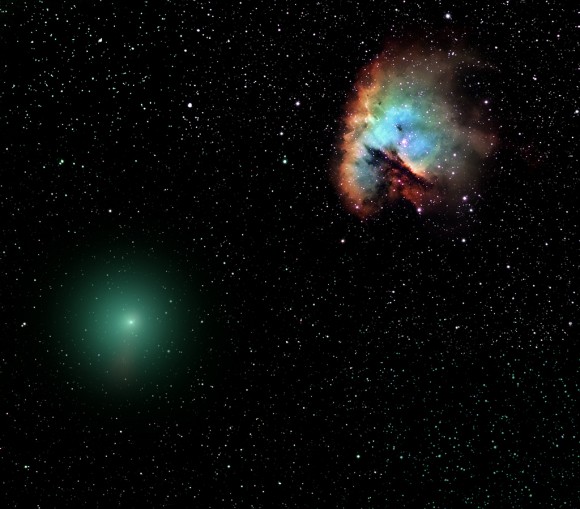
It took several weeks for Nick Howes of Cherhill, Wiltshire, UK to come up with this amazing image of Comet Hartley 2 and NGC281. But I’m sure you’ll agree with me – the wait is definitely worth it!
Nick Howes explained how he obtained this stunning photo.
“Initial run using an Atik 314L camera and narrowband CCD filters (Astronomik HA/OIII/SII and CLS) imaged the comet in the field of NGC281, using a multi pane wireframe approach (taking just a few subs for each of the 4 areas including the starfield/NGC281). Then the comet was imaged in full on the night of closest approach to NGC281, with 30-60s sub frames in HA/OIII/SII narrowband augmented by a CLS filter. where the OIII channel really lit up quite well. …gradually over several weeks, data was gathered to get enough sub frame time on the nebula in narrowband, mapping to a combination pallette of HST mapping and HA/OIII/SII, (total integration time around 12 hours in 300s sub frames), and the surrounding starfields. As the comet was moving very quickly, this was the only way it could be done to achieve this level of detail and complexity in the final image.”
Nick also provided us with the camera specs and imaging techniques he used. Atik 314L and Atik 4000CCD Manually composited, along with use of Registar/MAxim DL/Photoshop CS5 TMB105 F6.2 refractor Autoguided by PHD guide/ST102 EQ6 mount using EQ MOD and EQ Mosaic for the initial wireframe Processed in Maxim DL/Registar and Photoshop CS5 using Noels Actions and Focus Magic plug in/DDP processing in MAxim DL for Nebula, Deconvolution FT process on star fields and nebula in Maxim DL. More Cool Sites Here!!
Brandon Powers of Moultrie, Georgia captured this photo of M31, also known as the Andromeda galaxy. You can also see NGC 221 at the top and NGC 205 at the bottom. The Andromeda galaxy is the nearest spiral galaxy to the Milky Way at approximately 2.5 million light-years from Earth. According to the 2006 observations of the Spitzer Space Telescope, Andromeda galaxy contains around one trillion stars which is approximately twice the number of stars in the Milky Way. Brandon used a Nikon D90 camera attached to 12” LX200 telescope.
New imagery from NASA and NOAA satellites taken today (Sept 4) shows the extent of a hurricane season storm currently ravaging the US Gulf Coast and another potentially posing a new threat to US East Coast areas still suffering from the vast destruction caused by Hurricane Irene just days ago. Data from the NASA and NOAA satellites is critical in providing advance warning to government officials and local communities to save human lives and minimize property damage. . Slow moving Tropical Storm Lee has unleashed strong thunderstorms and heavy rainfall in several Gulf Coast states. Rainfall amounts of up to 7 to 14 inches over the last 48 hours are currently drenching coastal and inland communities – especially in Louisiana, Mississippi and Alabama along a wide swath that extends from Texas to the Florida panhandle. Isolated pockets of Gulf State areas may see up to 20 inches of rainfall. Severe flooding to homes and roads has occurred in some locations. Winds have diminished from 60 mph on Saturday (Sept. 3) to 45 mph on Sunday. Imagery and measurements from the Aqua and GOES-13 satellites from NASA and NOAA revealed that TS Lee finally made landfall in Louisiana after two days of drenching rain along the Gulf Coast.. A tropical storm warning is in effect on Sept 4 for New Orleans, Lake Pontchartrain, and Lake Maurepas. Fortunately the rebuilt levees in New Orleans appear to holding in the first serious test since the vast destruction of Hurricane Katrina. Other areas are less lucky.
Lee’s tropical force winds now extend out 275 miles from the center. A large part of Lee is still over the Gulf of Mexico where the driving wind and rain affected operations on some oil rigs. Lee has spawned more than a dozen tornadoes in the Gulf Coast states. The storm is spreading more heavy rain and winds on a northeast to east- northeast heading tracking towards Tennessee over the next 24 to 36 hours according to the latest weather forecasts. Meanwhile Hurrican Katia is packing winds of 110 MPH and is on a path that could cause it to make landfall on the Outer Banks of North Carolina just a week after the state suffered from Hurricane Irene. Hurricane Katia has the potential for effecting the launch of NASA’s GRAIL Lunar Mappers slated for liftoff on Sept. 8 from Cape Canaveral, Florida, depending on its exact course.
Irene caused extensive flooding and devastation on the hundred year scale in several US states still reeling from flooding and destruction. More than 43 deaths have been reported so far, including emergency rescue workers. Initial damage estimates are over $6 Billion. Thousands of East Coast homes and businesses are still without power as strong after effects from Irene continue to play out. President Obama toured flood stricken areas of Paterson, New Jersey today (Sept. 4). According to a statement by Rob Gutro, of NASA’s Goddard Space Flight Center, Greenbelt, Md; Tropical Storm Lee’s winds had dropped from 60 mph exactly 24 hours before to 45 mph at 8 a.m. EDT on Sept. 4. Lee’s center was over Vermillion Bay, Louisiana near 29.7 North and 92.0 West. It was crawling to the northeast near 3 mph (6 kmh) and expected to continue in that direction today, turning to the east-northeast tonight. Because Lee’s center is over land, he is expected to continue weakening gradually in the next couple of days. Lee’s outer bands still extend far over the Gulf of Mexico, bringing in more moisture and keeping the system going.
This photo of the Ursa Major, also known as the Big Dipper was captured by Tihomir Borzan above a beach in Croatia on Aug 14th 2011, 00:55 AM local time. Ursa Major is a prominent constellation that’s visible all throughout the year in most locations in the northern hemisphere. Its seven brightest stars form the famous Big Dipper.
“The photo was taken with a Panasonic DMC-TZ10 camera, with an F/3.3 aperture and a 60 second exposure time. I didn’t take any telescopes or a tripod of any kind, so I just put the camera down on a rock and made sure it kept still during the exposure time. Some other tech specs on the photo: ISO-80 sensitivity, 4 mm phocal length, all set by the in built night scene program in the camera. A nice feature is the GPS receiver of the camera, so I can give you the exact coordinates where I made the photo: 44° 18′ 39.11″ N, 15° 5′ 53.35″ E.”
For many exoplanet systems that have been discovered by the radial velocity method, astronomers have found excess emission in the infrared portion of the spectrum. This has generally been interpreted as remnants of a disk or collection of objects similar to our own Kupier belt, a ring of icy bodies beyond the orbit of Pluto. But as Kepler and other exoplanet finding missions rake in the candidates though transits of the parent star, astronomers began noticing something unusual: None of the exoplanet systems discovered through this method were known to have debris disks. Was this an odd selection effect, perhaps induced by the fact that transiting planets often orbit close to their parent stars, making them more likely to pass along the line of sight which could in turn, betray different formation scenarios? Or were astronomers simply not looking hard enough? A recent paper by astronomers at the Astrophysikalisches Institut in Germany attempts to answer that question.
In order to do so, the team compared the (at the time) 93 known transiting exoplanets to stars for which archival data was available through infrared missions such has IRAS, ISO, AKARI, and WISE. The team then searched the data looking for a previously unrecognized bump in the emission in the infrared. Many of the stars they searched were faint, due to distance, so most of the IR telescopes did not have images with sufficient depth to draw much in the way of conclusions. Between IRAS, ISO, Spitzer, and AKARI, the team was only able to examine three stars, and all of those came from Spitzer observations. The most plentiful return came from the WISE telescope which had 53 entries that overlapped with known transiting systems, one of which was excluded due to image defects. From these 52 candidates, the team found four that may have contained excess emission. To follow up, the team added observations from other observatories that lied in the near infrared (the 2MASS survey) and the visual portion of the spectrum. This allowed them to build a more complete picture of the brightness of the stars at various wavelengths which would make the excess stand out even more. While all four systems deviated from an ideal blackbody in the portion of the spectrum expected for a debris disk, only two of them, TrES-2, and XO-5, did so in a manner that did so in a statistically significant manner. While this study shows that debris disks are possible around transiting stars, it was only able to confirm their presence in two stars out of 52, or just under 4% of their sample. But how does that compare to systems discovered by other methods? One of the studies cited in the paper used a similar method of comparing archival data from IR observatories to known exoplanet system discovered by other methods in 2009. In this study, the team found debris disks around 10 of the 150 planet-bearing stars, which is roughly 7%. Due to the low return rate on both of these studies, the inherent uncertainty puts these two figures within a plausible range of one another, but certainly, more studies will be in order in the future. They will help astronomers determine just what difference exists, if any, as well as giving more insight into how planetary system form and evolve.
NASA has made tremendous progress during the past fifty years with regards to food science. Gone are the days of nutrients in toothpaste style tubes and it’s safe to assume NASA astronauts haven’t had to drink Tang in decades.
At a recent meeting of the American Chemical Society, Maya R. Cooper, senior research scientist at NASA’s Space Food Systems Laboratory discussed how feeding astronauts will be one of the most difficult issues to resolve before launching a manned mission to Mars.
Despite all the progress NASA has made, what challenges still need to be overcome to feed the crew of a manned mission to Mars?
When we plan a camping trip, not much thought is given to what will be eaten during a weekend, a week, or even a month’s time. Modern food science has given us products that are safe to eat after even weeks, and in some cases months. It is very easy to go to the store and load up on delicious and nutritious food, with the expectation that said food will be relatively safe to eat with minor concerns for safety.
Manned spaceflight however, isn’t your average camping trip. Even during a one to two week mission, NASA astronauts can’t just open a refrigerator and make themselves a cold-cut sandwich. Food scientists at NASA must specially prepare meals for astronauts in order to ensure said meals are safe to consume during the mission, not only for the crew, but for their habitat as well. The average can or bottle of pop wouldn’t provide the same level of safety and satisfaction for a crew in space as it would for a person on Earth. Food crumbs can clog air filters or become lodged into sensitive equipment. Basically, what works well for a camping trip doesn’t always work for an ISS mission and what works for the ISS crew may not work for a multi-year mission to Mars.
In her talk, Cooper discussed some of the issues such as food safety that she and her team currently address. Some of the other issues discussed included food packaging, nutrition, weight, and of course variety.
Cooper cited that the current daily allocation of food for manned spaceflight crews is just under four pounds per day. Estimating a five-year trek to Mars would require over 7,000 pounds of food. “That’s a clear impediment to a lot of mission scenarios,” Cooper said. “We need new approaches. Right now, we are looking at the possibility of implementing a bioregenerative system that would involve growing crops in space and possibly shipping some bulk commodities to a Mars habitat as well. This scenario involves much more food processing and meal preparation than the current food system developed for the space shuttles and the International Space Station.”
The idea behind bioregenerative systems is that plants could multi-task, not only providing food, but also removing carbon dioxide gas and releasing oxygen, just like plants on Earth. Plants that are prime candidates for a Mars mission would have very little inedible structure. So far, ten plants that require little room and grow with minimal work have been identified. A few of the ten ideal plants identified are lettuce, spinach, carrots, tomatoes, strawberries, some herbs and cabbage.
One other idea Cooper suggested for future manned missions to Mars, would be to ship food products ahead of time. Sending supplies in advance of a mission would result in less food and packaging flying onboard the manned spacecraft headed to Mars. There are a few questions regarding sending supplies in advance, namely what happens if a critical supply ship fails to reach Mars and whether current food preservation technology can guarantee adequate nutritional content for a mission to Mars.
“The NASA Advanced Food Technology project is currently working to address the issues of food variety, weight, volume, nutrition and trash disposal through research and external academic and commercial collaborations,” Cooper noted.
For those of us who had the opportunity to chase Comet Garradd this weekend, half the joy was catching it crossing the “Coathanger” cluster! In this great shot by Mike Romine, the comet appears along the curve of the upside down 2 of the asterism. Mike took this shot without a telescope, using a Canon EOS 50D, 135mm lens, F/5.6, ISO 1600, 90 seconds, mounted on a Celestron SCT on a CG5-GT mount at 12:45 AM. Nice catch!
Mike White captured this photo of the Southern Cross constellation, also known as Crux on March 17, 2010. Crux is a constellation that’s visible in the Southern hemisphere. It’s also the smallest of all the 88 modern constellations. The five main Crux stars are Alpha Crucis (Acrux), Beta Crucis (Mimosa), Gamma Crucis (Gacrux), Delta Crucis (Pale) and Epsilon Crucis (Nosy).
“The photo was taken on a tripod-mounted Canon S5is digital camera, and is a combination of 3 x 15 sec exposures at ISO 800, aligned in Gimp. It was taken from our rural property north of Levin, New Zealand. Just slightly below and to the left of the left-most star of the cross (Beta Crux, or Mimosa) is a small cluster known as the Jewel Box (NGC4755), which is a beautiful collection of different colored stars (hence its name) and a delightful sight in any size telescope.”